Dé Luain, Samhain 16, 2009

PSNI Repression on the Rise

16/11/09


The PSNI’s increasing reliance on the tactics of repression was highlighted yesterday [Sunday] when the force put in place a massive operation to deal with a sponsored walk on Belfast’s Black Mountain.

The walk was organised by éirígí activists to raise funds for the party and included a short demonstration and speech at a British military communications post on the mountain, which is on the outskirts of west Belfast.


However, as the 30 or so éirígí members and supporters were finishing their hike they were met by no less than seven armoured PSNI jeeps, two helicopters, 30 PSNI riot personnel and a number of unmarked cars.

The thugs in uniform proceeded to search, question and film those who were on the walk, as well as many bystanders who were out enjoying the winter sunshine on what is National Trust land.

Along with the adults searched at the scene, the PSNI also felt the need to search a child’s pram. At no stage did the officers involved explain what exactly it was they were looking for.

The scale of the operation caused a stir at the near-by Lámh Dhearg GAA pitch, where spectators had gathered to watch a football game, and resulted in many residents phoning a local newsroom to report the PSNI activity.


Amazingly, when contacted by journalists, the PSNI denied they had stopped or searched anyone on the Black Mountain.

The PSNI’s over-kill came only days after it was revealed that there were more than 12,000 stop & search incidents in the Six Counties under the British government’s ‘Terrorism Act’ and ‘Justice & Security Act’ between July and September this year.

éirígí general secretary Breandán Mac Cionnaith said: “The most recent figures on PSNI stop & search operations reveal a dramatic rise. This will be very worrying for the nationalist communities who have traditionally borne the brunt of British state repression.

“The figures on stop & search between July and September are three times the number for the previous quarter – this works out at an average of 110 stop & search operations every day.


“This is the reality of policing in the Six Counties. It is one that is far removed from what was promised by the nationalist parties who took the decision to endorse the PSNI.”

Mac Cionnaith continued: “These figures clearly show that the PSNI is not a civic police service – it is a politically-motivated paramilitary force, funded and armed by the British government for the purpose of protecting the occupation of the Six Counties.

“When it comes to policing nationalist communities, the PSNI’s idea of what is acceptable constitutes harassment on a massive scale, the firing of plastic bullets, raids and the use of CS gas and Tasers.

“However, it will soon become obvious to them that any amount of harassment will not deter éirígí activists from opposing the British occupation.”

Dé Sathairn, Samhain 14, 2009

Why You Should Join a Trade Union

14/11/09

In the corporate media of late, the subject that has been pursued with great zeal is that of union bashing.

Of course, it has been the same old story for the past 30 to 40 years but, now, as recession grips the whole country, the black propaganda machine has gone into overdrive. It may be asked why the establishment has upped the ante in its open warfare against the trade union movement in what is a critical economic period for Ireland.

The answer is simple; the unions are probably the only mass movement left to protect workers’ rights in light of the fact that workers have no representatives worth talking about in either Leinster House or Britain’s Stormont administration.

Trade union membership has been in steady decline in Ireland for approximately 20 years, mainly in the private sector, due to a number of factors, not least the so-called social partnership process having a pacifying effect on union activity.

In the early ’90s, the Twenty-Six County economy started to grow at an unprecedented rate and the prospect of full employment was being declared at every opportunity. The myth was repeated over and over again that the economic good times were here to stay and wages would continue to forge ahead. Business leaders done their damnedest to convince private sector workers that unions were an unnecessary hangover from a past of social conflict. Many swallowed the lie.

A prime example of private sector workers realising the predicament they were in without union representation was the workers of Anglo-Irish Bank.

The bosses in AIB always boasted of the lack of a union presence on the floors of their beloved bank. The workers were apparently happy with their lot while the bosses were upstairs gambling away the future of their staff. When the bank collapsed, the workers flooded into the ranks of the IBOA but, it was too late, the bank had been sold down the river. If there had been a union organised on the shop floors of AIB, some of the damage done may have been prevented before it came to pass, but that will always be a what if story.

There is a constant media focus on dividing the public and private sector workers and the reason is simple. The corporate media is run by the business class – it is in their interest to divide and conquer workers lest they feel the personal pinch due to an organised workforce.

What is most damaging to workers is division and that is exactly what the governments in power in Ireland and the corporate media are trying to ferment amongst staff in the private and public sector.

There are workers in the private sector who have lost their jobs, while others have taken pay cuts, who are now being encouraged to take pot shots at public service workers who face a similar plight.

The real enemy of both private and public sector workers, of course, is the small class of super rich – 1 per cent of the population - who control 40 per cent of the wealth. There are billions upon billions of euros of profits, made during the Celtic Tiger period by working people, that remain in the coffers of this coterie of legal gangsters. Despite the corporate cries for ordinary workers to take a hit, these billions will not be shared with the nation in its time of need.

The reason the likes of Michael O’Leary fear unions is not because they slow down progress within their companies but because they are a threat to the enormous profits they makes off the backs of their workers.

Trade unions in Ireland and elsewhere are far from perfect. Many people would be correct in saying that the present leaders of the unions in Ireland are far from inspiring. One of the progressive developments Ireland is in need of is a renewed and larger trade union movement and, with that, fresh leadership. At the present moment, the political establishment pays lip service to the unions; the power, wealth and common interests of the business class and most politicians combine to ensure that. If, however, there was a strong and cohesive union movement with a passionate, politically radical leadership, the establishment would have to take note of what the majority of workers are saying throughout the country.

The problems associated with joining a union in the private sector are well documented. These include promotions being denied and prospective union members being verbally abused and intimidated by their employers. However, individuals within any company are easy pickings for employers so long as they remain just individuals. Workers organised into a union are a different matter altogether.

The law with regards employment within the European Union may appear to hold out some hope for workers but, if you find yourself at opposing ends to your employer as an individual, it is a David and Goliath battle. The employers have the best access to the best employment lawyers that money can buy, individuals do not. However, when an individual joins a union, employers would have second thoughts about walking all over employment rights.

It should always be remembered that a union is not there to make a profit. Unlike employers, it is there to protect its memberships’ employment rights and to obtain a decent day’s pay for decent day’s work.

Workers in every facet of the economy should be organised in trade unions. Employers and their political allies have, yet again, effectively declared war on working people. It is time the majority organised in defence on their own interests, as James Connolly said: “We are many, they are few”.

Dé Máirt, Samhain 10, 2009

Thousands Attend Day of Action

10/11/09

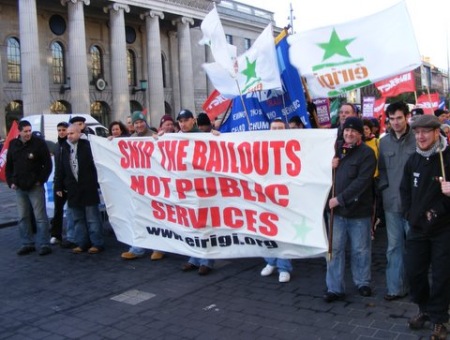
Over 100,000 workers took to the streets across Ireland on Friday [November 6] in a mass display of discontent with the policies of the Six and Twenty-Six County administrations.

Among the marchers were many éirígí activists, who took part in the Belfast, Cork, Dublin, Enniskillen and Sligo demonstrations.


The message sent out on the day was a militant one, with speakers warning that workers would not long carry the can for the failures of the business class and the political establishment.

In Dublin’s Merrion Square, SIPTU president Jack O’Connor said the labour movement in Ireland had always been asked to have regard for the “national interest” while the Twenty-Six County government made “a dog’s dinner of it”.


“What’s actually happening is that they’ve confused the national interest with the interest of the better off and the well-to-do and that’s a tragedy,” O’Connor continued.

At Belfast City Hall, UNISON’S Patricia McKeown warned workers that the next time they gather it would be on official strike action.


Further action was also promised by many other speakers. In Limerick, Mike McNamara, the president of the Council of Trade Unions in the city, said: “People don’t have any other choice at this stage. They are faced with this challenge that most people never had to face before and, when all other tactics have been used in the past like going into partnership, going into normal dispute mechanisms, in extraordinary times we just have to resort to revolutionary procedures to get what we want off the government.”

Speaking after he attended the Dublin demonstration, éirígí chairperson Brian Leeson noted that Friday’s strong turn-out was a warning to those who wanted to implement cuts in public services, jobs and pay.


“It is clear from attendances at rallies across the country that there a lot of angry people in Ireland at the minute.

“They are angry that, as workers, they are being forced to make the sacrifices for the abject failure of the business class and the political establishment. They are angry that their jobs are on the line, their pay is under threat and their conditions are under question because a small group of wealthy people squandered the wealth that was created by working people.


“They are angry that the public services on which they and their families rely are criminally under funded and facing further financial deficits because the governments that misrule this country would rather bailout bankers and glorified gamblers.

“They are angry that northing is being done about the spiraling rates of unemployment, while multinational companies are allowed to flee the country with the financial incentives that were gifted to them by compliant government bodies.


“In the time ahead, this anger must be channeled into an organised movement for the defence of public services, jobs, pay and conditions. Out of this anger should also come an alternative vision of how the Irish economy should be run – an alternative that places the public interests ahead of private greed.”

Leeson concluded: “Union leaders have put down a marker by indicating that mass action by workers is the way forward – they must not retreat from this marker.”

Dé hAoine, Samhain 06, 2009

Guth na Gaeltachta le cluinstin go láidir

06/11/09

(English version follows.)

Chonaic Oireachtas na Samhna i mbliana seoladh náisiúnta an fheachtais Guth na Gaeltachta in éadan mholtaí an Bhoird Snip Nua i dtaca leis an Ghaeilge agus agus ceantair Ghaeltachta na tíre.

Is é an tOireachtas an t-imeacht Gaeilge is mó sa bhliain agus, gach bliain, cruinníonn na deiche mílte daoine leis an teanga agus chultúr náisiúnta a cheiliúradh. D’ainneon an iliomad imeachtaí agus comórtas eile ag tarlú tráthnóna Dé Sathairn [31ú Deireadh Fómhair], líon cúpla céad daoine isteach i halla comhdhála san Óstán Mount Errigal ar son sheoladh an fheachtais.

Fuair an lucht féachana siamsaíocht ag an tús ón Chrann Óg, grúpa de cheoltóirí óga ó Ghaeltacht Ghaoth Dobhair, ansin labhair urlabhraí Ghuth na Gaeltachta, Éamonn Mac Niallais, labhair sé leis an lucht féachana.

Labhair Mac Niallais faoi thús an fheachtais nuair a bhí cúpla duine ag léamh tríd Thuarascáil an Ghrúpa Speisialta ar Uimhreacha na Seirbhíse Poiblí agus Cláir Chaiteachais sna Sé Chondae Fichead [tuairisc an Bhoird Snip Nua] agus ag feiceáil cé chomh holc agus a bhí na giorruithe molta.

Molann an tuairisc gearradh 9.4 faoin chéad, ar an mheán, i gcaiteachas i ngach rannóg rialtais sna Sé Chondae Fichead ach, nuair a bhí caiteachas ar an Ghaeilge, ar an Ghaeltacht agus ar na hoileáin i gceist, is é 58 faoin chéad an tsuim dhochreidte. Cuir seo i gcomparáid leis an gearradh 5.7 faoin chéad a moladh do Roinn Airgeadais na Sé Chondae Fichead, ar eisigh a haire féin an tuairisc i mí Iúil.

Le grúpaí ag teacht le chéile le cur in éadan na moltaí agus cruinnithe á n-eagrú ag mná tí i gceantair Ghaeltachta, rinneadh cinneadh grúpa a sheoladh a dhíreodh ar an teangar agus ar an Ghaeltacht.

Tháinig an grúpa aníos le cúig bhunphrionsabal a dtiocfadh le pobail Ghaeltachta troid air. Bad hiad seo:


*Roinn na Gaeltachta sna Sé Chondae Fichead a choinneáil faoi cheannas aire shinsirigh
*Cúrsaí fiontraíochta a bheith faoi chúram Údarás na Gaeltachta
*Oideachas Gaeltachta agus Gaelscolaícohta a chosaint
*Na scéimeanna forbartha teanga, cultúir agus ealaíona a choinneáil (agus a leasú más gá)
*Iontaobhas a sholáthar d’oibrithe caipitil, pobail agus infrastruchtúir i gceantair iargúlta ar nós na Gaeltachta

Tá dearcadh an Bhoird Snip Nua ar an Ghaeltacht le feiceáil go soiléir ina dtuairisc féin, a deir: “the Group notes that substantial resources have been invested in various incentive schemes to develop Gaeltacht areas. The Group is of the view that resources should be targeted at those most in need and that differential schemes aimed at Gaeltacht areas are not justifiable.”

Is é an scéal áfach go raibh ‘scéimeanna difreálacha’ de dhíth ar cheantair Ghaeltachta cionn is gur iad pobail Ghaeltachta a bhí, agus atá, is mó gátair. Bhí gá le bunú Údarás na Gaeltachta mar rinneadh neamart ar cheantair Ghaeltachta, mar na ceantair is iargúlta sa tír, nuair a bhí fostaíocht agus forbairt eacnamaíocht i gceist.

Go cosúil, bhí gá le bunú na Comhairle um Oideachas Gaeltachta agus Gaelscolaíochta [COGG] de bhrí nach raibh Roinn Oideachais na Sé Chondae Fichead ag freastal ar riachtanais na bpáistí ag na scoileanna seo. Anois, molann an tuairisc COGG a dhíothú agus scoileanna le níos lú ná 100 dalta a chónascadh, rud a mbeidh éifeacht mhillteach aige i gceantair Ghaeltachta, inar scoileanna beaga iad formhór na scoileanna.

Tá borradh ag teacht faoi Guth na Gaeltachta ónar bunaíodh é i nGaoth Dobhair i mí Lúnasa. Ar 29ú Meán Fómhair, ghlac Comhairle Chondae Dhún na nGall d’aon ghuth le rún ag tacú le Guth na Gaeltachta agus a n-aidhmeanna, agus cuirfear an rún seo anois chuig achan chomhairle i stat na Sé Chondae Fichead.

Ag labhairt ag an seoladh Dé Sathairn, ghlaoigh Mac Niallais ar Ghaeilgeoirí ar fud na tire páirt a ghlacadh trí bhrú a chur ar a n-ionadaithe áitiúla tacaíocht a thabhairt don fheachtas agus stop a chur le cur i bhfeidhm na moltaí millteacha seo.

Nuair a chríochnaigh sé, labhair daoine ó gach Gaeltacht sa tír amach ag tacú leis an fheachtas agus ag éileamh aontachta in éadan an Bhoird Snip Nua. Ag an deireadh, labhair déagóir ó Dhún na nGall faoin dóigh ar throid muintir na hÉireann le 800 bliain lena dteanga agus cultúr a chaomhnú ó na Gaill, agus cé chomh náireach a bhí sé go bhfuil orainn anois troid ar a son in éadan daoine ónar dtír féin.

Is sampla é an Bord Snip Nua den chineál talamh gan rath cultúrtha a bheas fágtha má éiríonn le heacnamóirí BÁC 4.


Guth na Gaeltachta le cluinstin go láidir

This year’s Oireachtas na Samhna saw the national launch of the Guth na Gaeltachta campaign against the recommendations of the Bord Snip Nua report relating to the Irish language and to the Gaeltacht regions of the country.

The Oireachtas is the largest Irish language event of the year and, each year, tens of thousands of people congregate to celebrate the national language and culture. Despite numerous other events and competitions taking place on Saturday afternoon [October 31], several hundred people crammed into a conference hall in the Mount Errigal Hotel for the launch of the campaign.

The crowd was entertained at the beginning by An Crann Óg, a group of young musicians from the Donegal Gaeltacht, then, the spokesperson of Guth na Gaeltachta, Éamonn Mac Niallais, addressed the audience.

Mac Niallais spoke of how the campaign had started with a number of people reading through the Twenty-Six County Report of the Special Group on Public Service Numbers and Expenditure Programmes [the Bord Snip report] and realising how bad the proposed cuts were.

The report recommends, on average, a 9.4 per cent cut in spending in each governmental department in the Twenty-Six Counties but, when it came to spending on the Irish language, on the Gaeltacht areas and the islands, the proposed cuts amounted to an astounding 58 per cent. Compare this to the 5.7 per cent cut proposed for the Twenty-Six County Department of Finance, whose own minister released the report in July.

With groups coming together to oppose the recommendations and meetings being held by mná tí [housewives] in Gaeltacht areas, a decision was made to launch a group that would focus on the language and on the Gaeltacht.

The group came up with five fundamental principles that Gaeltacht communities could fight on. These were:


*To keep the Gaeltacht Department in the Twenty-Six Counties with a senior minister at its head
*For Údarás na Gaeltachta to take care of enterprise matters
*To protect Irish-medium and Gaeltacht education
*To keep the language, culture and art development schemes (and reform them if necessary)
*For a trust to be made available for capital, community and infrastructure works in remote areas like the Gaeltacht

An Bord Snip Nua’s perspective on the Gaeltacht can be seen clearly in its own report, which reads: “the Group notes that substantial resources have been invested in various incentive schemes to develop Gaeltacht areas. The Group is of the view that resources should be targeted at those most in need and that differential schemes aimed at Gaeltacht areas are not justifiable.”

The issue, though, is that Gaeltacht areas required “differential schemes” because Gaeltacht communities were, and are, most in need. Údarás na Gaeltachta had to be established because Gaeltacht areas, as the most remote areas in the country, were being ignored when it came to employment and economic development.

Similarly, An Chomhairle um Oideachas Gaeltachta agus Gaelscolaíochta [the Council for Gaeltacht and Irish-medium Education, COGG] had to be set up because the Twenty-Six County Department of Education was not attending to the needs of the children at these schools. Now, the report recommends abolishing the COGG and amalgamating schools of less than 100 pupils, which will have a devastating impact in Gaeltacht areas, where most schools are small schools.

Guth na Gaeltachta has been growing in support since it was first established in Gaoth Dobhair in August. On September 29, Donegal County Council unanimously accepted a motion in support of Guth na Gaeltachta and its objectives, and this motion will now be sent to every council in the Twenty-Six County state.

Speaking at the launch on Saturday, Mac Niallais called on Irish speakers all around the country to get involved by putting pressure on their local representatives to support the campaign and to stop these devastating proposals from being enacted.

When he finished, people from every Gaeltacht in the country spoke up in support of the campaign and called for unity against An Bord Snip Nua. At the end, a teenager from Donegal spoke of how the people of Ireland had fought for 800 hundred years to preserve their culture from foreign invaders, and of the shame that now we have to fight for it against those within our own country.

An Bord Snip Nua is an example of the kind of cultural wasteland that will be left behind if the Dublin 4 economists get their way.

Dé hAoine, Deireadh Fómhair 30, 2009

Cé a Thugann Cúram do na Cúramóirí?
(30/10/09)


(English version follows)

Agus an éigeandáil eacnamaíoch, cruthaithe ag teipeanna agus saint gan srian an chórais chaipitligh, agus í ag leanacht léi, cluineann muid a lán ó na meáin agus scothaicme polaitíochta agus ghnó faoin dóigh a bhfuil muid uilig “istigh i seo le chéile”.

Ach déantar beagán riamh don fhadhb sheanbhunaithe faoi dtaobh de dhúshaothrú shaothar an lucht oibre. Déanann siad plé fada ar na ciorruithe a deir siad atá de dhíth le geilleagar teipthe na hÉireann a chobhsú, na giorruithe pá is gá a dhéanamh agus “cé a ghlacfas an buille”. Tá an chum air áfach gur éalaigh sé ó aird na ndaoine seo gur, le fada an lá, gur gnáthfhir agus gnáthmhná an lucht oibre atá ag glacadh an bhuille.


Glac mar shampla an foireann in Áras Ghaoth Dobhair, teach altranais i gCondae Dhún na nGall. I bhfad sula raibh aon trácht ar ghéarchóra creidmheasa agus ar mheathlú agus na giorruithe dá éis, bhí foireann an tí altramais seo – bunaithe in 2004 ag páirtíocht den FSS [HSE], Údarás na Gaeltachta agus grúpa pobail áitiúil le cúram a thabhairt do mhuintir aosta agus easlána na háite – ag éileamh pá agus coinníollacha cothroma ar par leo siúd i dtithe altramais an FSS.

Tá an cúram agus aird atá ag cúramóirí agus foireann Áras Ghaoth Dobhair dá n-othracha soiléir nó tá an t-aighneas seo ag dul ar aghaidh le breis agus trí bliana agus díreach anois atá an cinneadh déanta acu dul ar stailc. Thug an fhoireann fógra dhá mhí faoin stailc don teach altramais freisin, ag ligint do shocruithe bheith déanta le cinntiú nach mbeadh aon drochthoradh ar na cliaint. Rinne na hoibrithe agus a n-ionadaithe ceardchumainn a seacht ndícheall le stailc a sheachaint, ach fágadh iad gan dara rogha nuair nár fhill an fostóir ar an cheardchumann le moladh chun deireadh a chur leis an aighneas, mar a bhí aontaithe. Le taca ó SIPTU, chuaigh foireann an tí altramais ar an líne phicéid Dé hAoine 23ú Deireadh Fómhair do stailc 48 uair in iarracht téarmaí agus coinníollacha oibre ar aon dul le fostaithe FSS ag déanamh an job chéanna.

Cé nach saoráid an FSS é an teach altramais, freastalaíonn sé den chuid is mó ar othracha FSS agus rinne amhlaidh ónar oscail an áit. Ach faigheann an fhoireann a thugann cúram do na hothracha seo – d’ainneoin go bhfuil beagnach gach leaba léasaithe ag an FSS agus an fhoireann traenálaithe ag an FSS agus foireann bhainistíochta ón FSS – faigheann siad pá agus coinníollacha níos ísle ná mar atá sa FSS. Ní fhaigheann siad teidlíocht phinsin ná pá breoiteachta. Baintear laethanta tinne óna saoire bhliantúil agus tá a bpá i bhfad níos lú ná leath an phá a fhaigheann daoine fostaithe in aonaid an FSS.


Mar is gnáth, seachnaíonn an FSS an cheist ar bhealach cosúil lena máistrí polaitiúla, trí rá nach bhfuil aon rud le rá acu ar an ábhar. Deir siad nach saoráid de chuid an FSS é Áras Ghaoth Dobhair, d’ainneoin an pháirt mhór ina bhainistiú agus gur as an earnáil phoiblí iad tromlach mór na n-othracha. Cé go bhfuil na fostaithe dícheallacha seo ag tógáil maide as uisce do bhainistíocht an FSS, agus cé go ndéanann siad an obair seo go dothuirsithe agus le tiomantas iomlán dá n-othracha, déanann siad é do bheagán airgid agus faoi théarmaí míchothroma.

Tá an cheist seo ina sampla d’éagomrathais an chórais anseo sna 26 Condae. Thig leis an FSS dul i bhfolach faoin nóisean go bhfuil an teach altramais bainistithe go príobháideach, ach ní thig leo droim a thabhairt do na hoibrithe a thugann cúram d’othracha FSS ná teacht i dtír ar a bpaisean dá gcuid oibre. Tá dualgas ag an FSS aire a thabhairt dá n-othracha agus an fhoireann bhanaltrachta araon, mar an gcéanna leis an rialtas.

Ghlaoigh urlabhraí éirígí Thír Chonaill Mícheál Cholm Mac Giolla Easbuig, a sheas gualainn le gualainn leis na hoibrithe ar an líne phicéid, ghlaoigh sé ar gach oibrí agus ar an phobal ar fad seasamh leo siúd atá ar stailc.

Dúirt Mac Giolla Easbuig: “Moltar na oibrithe san aighneas seo as an ghníomh s’acu. Tá tacaíocht gach oibrí agus an pobal ar fad anseo in Iarthar Thír Chonaill tuilte acu.”

Lean sé leis: “Dlíonn na oibrithe anseo go gcaitear leo le meas agus go cothrom le hoibrithe eile fostaithe ag an HSE atá ag déanamh obair chosúil. Leagann sé béim arís eile an gá do dheireadh leis an scoilt phoiblí/phríobháideach inár seirbhís shláinte. Níl aon áit do chomhlachtaí príobháideacha i soláthar chúram sláinte.”


Who Cares for the Carers?
(30/10/09)


As the continuing economic crisis created by the failures and the unbridled greed of the capitalist system rumbles on, we hear much from the media and the political and business elite as to how we are supposedly "all in this together".

But little is ever made of the long standing problem of how the labour of the working people is exploited. They discuss at length the cut backs they claim need to be made to stabilise the failed Irish economy, the pay cuts that need to be made and “who should take the hit”. However it seems to have escaped the attention of these people, that for a long time, it has been the ordinary working men and women who have been taking the hit.

Take as an example the staff of Arás Gaoth Dobhair, a nursing home in County Donegal. Long before there was any mention of credit crunches and recessions and the subsequent cut backs, the staff of this nursing home - set up in 2004 by a partnership of the HSE, Údarás na Gaeltachta and a local community group to care for the elderly and infirm of the area - were calling for fair pay and conditions on a par with those in similar HSE nursing homes.

The care and attention the carers and staff of Arás Gaoth Dobhair have for their patients is evident in the fact that this dispute has been ongoing for over three years and only now have they taken the decision to strike. The staff also gave the nursing home two months notice of their strike, allowing for provisions to be made to ensure there would be no negative impact on the clients. The workers and their union representative's have done all they could to avoid the strike action, but they were left with no alternative when the employer failed to revert to the union with a proposal to end the dispute, as had been agreed. Backed by SIPTU, the nursing home staff took to the picket line on Friday 23rd October for a 48 hour strike in an effort to try and achieve similar working terms and conditions in line with HSE employees doing the same job.


The nursing home, while not a HSE facility, caters mainly for HSE patients and has done so since it opened. However the staff who care for these patients - despite nearly all of the beds being leased by the HSE and the staff trained by the HSE and management staff from the HSE – have inferior pay and conditions compared to those in the HSE. They do not receive pension entitlements or sick pay. Days off sick are deducted from their annual leave and their pay is considerably less than that of staff employed in HSE units.

Typically, the HSE avoid the issue in a similar vein to that of their political masters, by saying that they have no comment to make on the issue. They say Arás Gaoth Dobhair is not a HSE facility, despite having such a hand in its running and that a large majority of the patients are from the public sector. Despite the fact that these hard working employees are picking up the slack to cover the backs of the HSE management and despite the fact, that even though they do this work tirelessly and with total commitment to their clients, they do it for a relative pittance and with unfair terms.

This whole issue is an example of the inequalities of the system here in the 26 counties. The HSE might hide behind the notion that the nursing home is privately run, but they cannot turn their backs on the workers who care for HSE patients and take advantage of their passion for their work. The HSE have a responsibility to look after both the patients and the nursing staff, as indeed do the government.

Tír Chonaill éirígí spokesperson Micheál Cholm MacGiolla Easbuig, who has stood side by side with the workers on the picket line, has called for all workers and the entire community to stand behind those carrying out this strike action.

MacGiolla Easbuig said: "The workers involved in this dispute are to be commended for their actions. They deserve the support of all workers and indeed of the entire community here in West Donegal."

He added: "The workers here deserve to be treated with respect and treated equally with other workers employed by the HSE who are carrying out similar duties. It highlights once again the need for an end to the public/private divide in our health service. There is no place for private companies in the provision of health care."

Dé hAoine, Deireadh Fómhair 23, 2009

Todhchaí na hEite Clé
23/10/09

(English version follows)

An mhí seo (Deireadh Fómhair) bhí Deireadh Seachtaine Pheadar Uí Dhónaill ar shiúl sa Chlochán Liath, Condae Dhún na nGall.

Ba as an Chlochán Liath ó dhúchais é Peadar Ó Dónaill, a rugadh in 1893, agus lena óige chonaic sé éagóir agus anró an lae, rud a rinne smaointeoir polaitiúil agus sóisialta de ag aos óg.

É oilte mar mhúinteoir, is fearr aithne ar an Dálach inniu as a bhuanna liteartha leathana. Ach freisin bhí sé ina ghníomhaíoch poblachtach, cheannaire ceardchumainn agus shóisialaí ag leanúint íde-eolaíocht Shéamuis Uí Chonghaile agus chreid sé gurbh é réabhlóid shóisialta an bealach chun cinn d’Éirinn neamhspleách láidir.

Tá deireadh seachtaine Pheadar Uí Dhónaill agus cuid mhaith dóibhsean ar mhaith leo a shaol agus a linne a phlé anois ag díriú isteach go mórmhór ar litríocht Uí Dhónaill ach i mbliana tharla díospóireacht phoiblí faoin teideal ‘Todhchaí na hEite Clé in Éirinn’. Chuimsigh an painéal díospóireachta páirtithe polaitiúla den eite chlé, éirígí san áireamh, faoi ionadaíocht urlabhraí an pháirtí Daithí Mac An Mháistír.

Ba é comhaontú ginearálta an phainéil go raibh an eite dheis, gan trácht ar cén páirtí a sheas siad leis, go raibh an eite dheis aontaithe in iarrachtaí chun bonn a bhaint ón eite chlé agus chuige sin, gnáthmhuintir na hÉireann. Bhí seo soiléir i ngeáistí na bpáirtithe Fianna Fáil, an Comhaontas Glas, Fine Gael agus an Lucht Oibre ag caolú aníos chuig a chéile ag aontú in éadan mhuintir na hÉireann agus á mbrú go mídhaonlathach ar ais ag vótáil i reifreann Liospóin 2. Le bréaga agus le beartaíocht scanraithe chuir siad dallach dubh ar na toghthóirí le vótáil Tá in iarracht taca a chur le córas caipitleach na hEorpa.

Tá na páirtithe seo, a maíonn cuid acu gur den eite chlé iad, tá siad comhpháirteach, mura freagrach go díreach, i gciorruithe i sláinte agus san oideachas, i bhfeirmeoireacht agus in iascaireacht, agus i gcailliúintí fostaíochta go náisiúnta. Ciorruithe curtha i gcrích ag polaiteoirí agus maorlathaigh ag déanamh a seacht ndícheall chun a bpost agus a dtuarastal spleodrach a shábháil. Polaiteoirí a thóg costaisí seafóideacha do stíl mhaireachtála rábach ar íoc na cáiníocóirí astu á ligint saor. Tá na gníomhartha seo uilig i bhfad ó aon tuairim de shochaí chothromaíoch.

Luaigh duine den phainéal gur rud é go raibh breis agus 100 duine brúite isteach i seomra thuas staighre i seanteach pobail ag am lóin Dé Domhnaigh le polaitíocht na heite clé a phlé ina athrú ó mar a bhí sé in Éirinn tráth agus ina chomhartha don staid ina bhfuil an tír faoi láthair.

Ag labhairt ag an imeacht, dúirt urlabhraí éirígí Daithí Mac An Mháistír gurbh é an bhuncheist a bhí le cur ag an eite chlé ná cad é a ionann agus bheith i do shóisialaí agus cad é atá le déanamh ag an eite chlé go mbeidh an lámh in uachtar ag smaointeoireacht shóisialach thar an chóras caipitleach.

Dúirt sé gur gá dúinn ár sóisialachas a sháinmhíniú agus nach bhféadfadh Éire bheith cothrom ná ceartas sóisialta bheith inti gan diúlto don chaipitleachas, gur gá dúinn diúltú do dhúshaothrú shaothar dhaoine. Gan diúltú don smaoineamh de dhaoine nach mór dóibh obair 7 lá sa tseachtain ach nach bhfuil ábalta soláthar go fónta dá dteaghlaigh agus gan dreim acu ar fhostaíocht inbhuanaithe, leanfadh an córas caipitleach ag rathú.

Lean Mac An Mháistír go bhfaca sé difear san óige mar mhúinteoir agus go bhfuil siad anois níos eolaí ar an chóras polaitiúil agus go bhfuil siad ag cur ceisteanna agus ag fiosrú faoi dhaoine ar nós Karl Marx agus na híde-eolaíochtaí polaitiúla a bhí acu. Tá siad ag cur na n-íde-eolaíochtaí seo le sochaí an lae inniu agus ag fáil tuisceana iontu. Is féidir gur maith an tuar seo don todhchaí.

Rinne baill eile den phainéal agus daoine sa lucht féachana macalla ar an cheist a chuir Mac An Mháistir faoin treoir a chóir go mbeadh ag eite chlé na hÉireann sa lá atá inniu ann. Is ceist í seo ar féidir le muintir náisiún na hÉireann amháin a fhreagrú.

Go cinnte, tá sé de dhualgas ag gach páirtí den eite chlé in Éirinn obair le chéile chun teacht ar chomhtreoir pholaitiúil atá chun tairbhe na ndaoine. Ach caithfidh daoine an náisiúin freisin a gcumhacht a úsáid, ar na sráideanna, san áit oibre agus ag vótáil, chun athrú tairbheach a dhéanamh. Ansin amháin a tchífidh muid deireadh le polaitíocht truaillithe agus deachtóireachtúil na heite deise, agus Éire níos cothroime, córa agus firmeálta go heacnamúil.

Tá neart le déanamh againn. Mar a dúirt an Dálach féin, "Let us fling ourselves among the most fervent of social and economic revolutionists. Let us enlist the labour world in our struggle with our tyrannical masters."


The Future of the Left
23/10/09
 
This month (October) saw the annual Peadar O'Donnell Weekend held in Dungloe, County Donegal.

Peadar O'Donnell, born in 1893, was a native of Dungloe and, in his formative years, saw the injustices and hardships of the time, leading him, at an early age, to become a social and political thinker.

Trained as a teacher, O'Donnell is more widely known today for his extensive literary accomplishments. But he was also an Irish republican activist, trade union leader and a socialist, following the ideology of James Connolly, and believed social revolution was the way forward for a strong independent Ireland.

The Peadar O'Donnell weekend and many who wish to discuss his life and times may now concentrate more on O'Donnell's writings, but, this year, a public debate was held entitled 'The Future of the Left in Ireland'. The debating panel was made up of political parties of the left, including éirígí, which was represented by party spokesperson Daithí Mac An Mháistír.

The general consensus of the panel was that the political right, regardless of which party flag they stood under, were united in doing as much as they could to undermine the left and with that, working people in general. This was no more evident than with the antics of Fianna Fáil, The Green Party, Fine Gael and Labour sidling up to each other to unite against the electorate in the Twenty-Six Counties and undemocratically force them back to the polls in the Lisbon 2 referendum. With lies and scare tactics they hoodwinked the electorate to vote yes, all in an effort to shore up the capitalist system of the EU.

These parties, some of who claim to be of the left, have been complicit in, if not directly responsible for, cuts in health and education, in farming and fishing and have connived at job losses nation wide. The unemployment figure in the Twenty-Six Counties is now heading towards 15%. Cuts are carried out by politicians and bureaucrats who do their best to secure their own jobs and exorbitant wages. Politicians who have claimed ridiculous expenses for lavish lifestyles paid for by the tax payer are let off the hook. All these actions are far from any notion of an egalitarian society.

It was noted by one of the panelists that the very fact that the debate saw over 100 people crammed into an upstairs room in a converted church at lunchtime on a Sunday to debate and discuss the politics of the left was such a change from what Ireland once was and was also indicative of the situation the country was now in.


Speaking during the event, éirígí spokesperson Mac An Mháistír said that the fundamental question that had to be asked of the left is what it is to be socialist and what it is those on the left have to do to see socialist thinking win out over the capitalist system.

He said that we must define our socialism and that Ireland could not be equal or have social justice without a rejection of capitalism, that we must reject the idea of the exploitation of the labour of people. Without the rejection of the idea of people having to work long hours 7 days a week but yet not being able to provide adequately for their families and having no prospect of sustainable employment, the capitalist system would continue to thrive.

Mac An Mháistír continued that, as a teacher, he noticed a difference in the youth in education in that they are now much more aware of the political system and are now asking questions and looking for answers to today’s inequalities and enquiring into who people such as Karl Marx were and what their political ideologies were. They are using these ideologies to analyse today’s society and finding in them an understanding. All of which could bode well for the future.

The question posed by Mac An Mháistír of what should be the direction of modern day Ireland's political left was echoed both from other panel members and those in the audience. This is only a question that can be answered by the people of the Irish nation.

Certainly, it is incumbent upon all of the leftist parties in Ireland to work together to find a common political direction that benefits people best. But the people of the nation must also use their power, on the streets, in the workplace and in the polls, to make a change for the better. Only then will we see an end to the corrupt and dictatorial politics of the right and a fairer, just and more economically stable Ireland.

We have much to do. As Peadar O'Donnell once said, "Let us fling ourselves among the most fervent of social and economic revolutionists. Let us enlist the labour world in our struggle with our tyrannical masters."